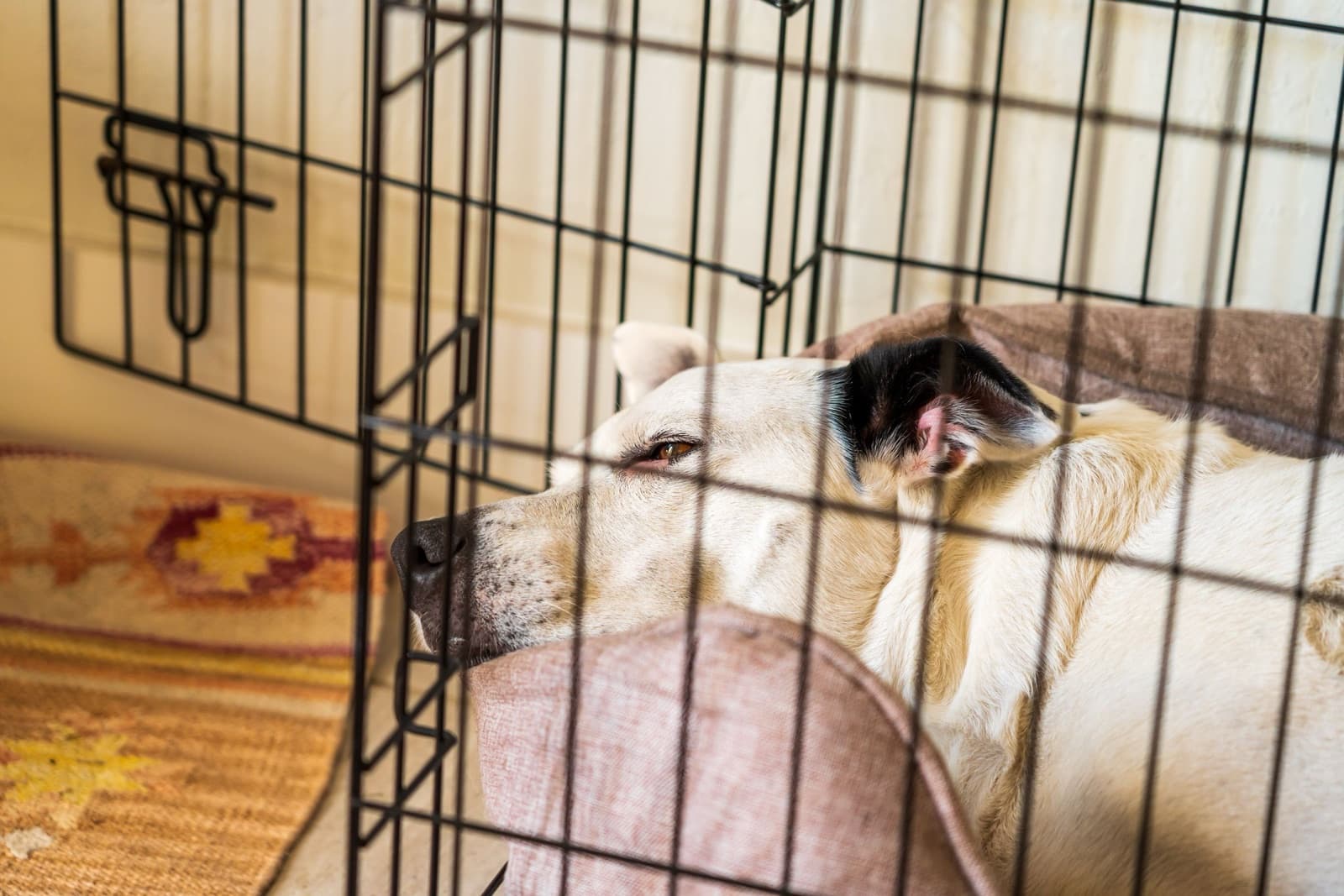
Crate training divides people, usually because they are arguing about two different things. One camp is describing a dog that goes into an open crate to sleep because that is where it is comfortable. The other is describing a dog shut in a box for nine hours because nobody taught it anything else.
The first is a genuinely useful thing to build. The second is the failure mode. What follows is how to get the first, in about four weeks, and how to tell early if it is not going to work for your particular dog.
What a crate is for
Four honest reasons, and they are practical rather than ideological.
- House-training. A puppy will avoid soiling where it sleeps, so a correctly sized crate turns toilet training from guesswork into a schedule.
- Safety when you cannot watch. A puppy alone in a house finds cables, socks and baseboards. Intestinal obstruction from a swallowed object is a real veterinary emergency, and a crate is the cheapest way to prevent it.
- Rest. Puppies sleep a great deal, in many short bouts, and most will not take it in a busy room. The figures repeated online — eighteen or twenty hours a day — are higher than anything measured: the Generation Pup cohort study put owner-reported sleep at a mean of about 11 hours in a 24-hour period at sixteen weeks, though owners were not observing directly and the study says so. The number matters less than the pattern. A great deal of what looks like a badly behaved puppy is an overtired one.
- The rest of life. Dogs travel in crates, recover from surgery in crates, and stay in them at boarding kennels and veterinary clinics. A dog that already finds a crate unremarkable has a much easier time on the worst days of its life.
What a crate is not: a punishment, a substitute for exercise, or somewhere to leave a dog for a working day.
The Canadian part
Three things push harder here than the guidance written elsewhere assumes.
Winter concentrates everything indoors. From November to March a puppy is inside far more, walks are shorter, and the household is on top of each other. A dog with a settled resting place handles that far better than one with nowhere to be. The winter care guide covers replacing lost walking distance with indoor work.
A lot of us live in apartments and condos, and how exposed that leaves you depends on the province. Noise complaints are the mechanism by which people lose pet-friendly housing, and a puppy that has never learned to settle alone is a puppy that howls at 8 a.m. In Ontario a no-pets clause in a lease is void, but a landlord can still act on a particular animal's behaviour — so the complaint, not the clause, is the risk. In British Columbia a lease may prohibit pets outright and breaching it can end the tenancy. Either way the exposure runs through the noise, and crate work and alone-time training are the same project. If you rent, the renting guide covers what to establish and get in writing first. Condominium rules are a second rulebook in both provinces, and the stricter one wins.
Distances are long. Driving anywhere in this country involves hours in a car, and a crated dog is safer in a collision and calmer on the way.
Choosing the crate
Type. Wire crates are the default: they fold, they take a divider, and a cover turns one into a den. Plastic airline-style carriers are enclosed and better for the car and for travel. Fabric crates are for dogs that are already trained, not for puppies, who will simply chew out.
Size is where most people go wrong, in both directions. The dog should be able to stand without ducking, turn around, and lie fully stretched out. Bigger than that and a puppy will happily toilet at one end and sleep at the other, which removes the main house-training benefit. So buy the crate for the adult dog and use the divider to shrink it, moving the divider back as the puppy grows.
Where to put it. For the first few weeks, in your bedroom. A puppy that can hear people settles much faster than one shut in a dark kitchen, and you will hear the difference between a puppy that is bored and a puppy that needs to go out. Later, if you want it elsewhere, move it gradually — a few feet at a time — rather than in one jump.
What goes in it. A flat bed or a folded blanket, and something safe to chew. No collars with tags or anything else that can catch on wire.
Four weeks, roughly
The pace below is a guide, not a schedule. Some puppies compress it into ten days. If yours takes six weeks, that is a slower puppy, not a failure.
Days 1–3: the crate is where food happens
Door open, propped so it cannot swing shut. Every meal goes in the crate — at the entrance first, then further back as the puppy is willing. Scatter a few pieces of food in there at random moments during the day so the puppy finds them on its own.
You are not asking for anything yet. No door, no duration, no command. The only objective is that the crate becomes the most interesting piece of furniture in the room.
Days 3–7: closing the door
Once the puppy walks in without hesitation, close the door while it eats and open it again before it finishes. Build from a few seconds to a minute or two, sitting right there.
Add a word at this point — “crate,” “bed,” whatever you will actually say — just as the puppy is already going in. Add a release word too, and use it every time the door opens. The release matters more than people expect: it tells the dog that coming out is your decision and not the result of scratching.
Week two: duration, and you in the room
Extend to five, then ten, then twenty minutes with the puppy settled and you nearby, reading or working. Give something long-lasting to chew. Cover part of the crate if it helps the puppy switch off.
Start using it for naps rather than only for training sessions. Enforced naps are one of the highest-yield things you can do with a young puppy.
Week three: leaving the room
Step out for ten seconds. Come back before there is any protest, without fuss. Build up: a minute, five, twenty. Vary it — sometimes short, sometimes longer — so your leaving stops predicting anything.
Do the departure ritual. Pick up keys, put on shoes, open the front door, come back in and sit down. Repeat it until it is boring.
Week four: real absences
Leave the house properly: two minutes, then ten, then thirty. Keep going out and coming in undramatic at both ends — no long goodbye, no reunion party.
By the end of the month a typical puppy will go into the crate on cue, settle for a nap with the door shut, and tolerate a short absence without distress. That is the whole goal.
Nights
Nights are their own thing and they are usually the hardest part of the first fortnight.
Crate in the bedroom. Last toilet trip immediately before bed. Expect one or two night trips at the start: get up, outside, no talking, no play, straight back in. Anything interesting that happens at 3 a.m. will be requested again at 3 a.m.
Distinguish the two sounds. A puppy that grumbles for a minute and settles is complaining. A puppy escalating and not stopping usually needs to go out. Getting this wrong in the cautious direction costs you a pointless trip outside; getting it wrong in the other direction costs you a soiled crate and a setback.
How long is too long
There is a rule of thumb in wide circulation — a puppy can hold on for roughly its age in months plus one hour — and we have taken it out of this guide, because we could not find a veterinary source for it and a formula that produces “four hours” for a three-month-old is the kind of number people plan a working day around.
What veterinary guidance gives instead is intervals rather than a capacity. VCA’s house-training guidance is to take a puppy out every one to two hours while it is awake, every four hours even if it has been resting, after meals, after naps, and roughly every half hour during energetic play, with overnight outings often still needed until around five months. On confinement specifically it puts the ceiling at no more than about three hours alone in a crate, after which a puppy needs a break regardless.
Capacity varies with age, size, how much the puppy has drunk, how active it has been, and whether it is awake or asleep. Work from the puppy in front of you and its own established pattern, not from a clock — and never stretch confinement to make a number fit.
Overnight is different from daytime, because a sleeping puppy is not producing urine at the same rate.
If your day is longer than the dog can manage, the answer is a midday visit from a person, or a pen rather than a crate, or daycare — not a longer stretch in the crate. This is a genuine ongoing cost and it belongs in the budget before you get the dog; the cost guide covers where it fits.
The five mistakes
- A crate that is too big. The puppy sleeps at one end and toilets at the other, and you have lost the house-training benefit entirely.
- Using it as punishment. Send a dog there after it does something wrong and you have spent the association you were building.
- Opening the door while the puppy is screaming. You have taught, very efficiently, that screaming opens doors. Wait for a pause, however brief, then release. If the noise never stops, you moved too fast — go back a step rather than fighting it out.
- Going too fast. Almost every crate problem is a training plan that skipped the boring middle.
- Leaving too long, too soon. The crate is not the problem in that scenario; the schedule is.
When the crate is the wrong tool
Some dogs do not settle in a crate, and a minority become genuinely distressed rather than merely annoyed. The distinction matters: complaining fades, distress escalates.
Signs to take seriously are persistent panic that does not reduce over sessions, drooling or panting well beyond warmth, soiling in a previously clean crate, and any attempt to dig or chew out that risks injury to teeth, nails or mouth.
For a dog that will not take to a crate, an exercise pen, a baby-gated room or a puppy-proofed utility room achieve most of the same containment. You lose some of the house-training precision and keep the safety. That is a reasonable trade, and it is a better outcome than winning an argument with a frightened animal.
Getting it right
- Crate bought for the adult dog, with a divider to shrink it now
- Positioned in the bedroom for the first few weeks
- Every meal fed inside it, door open, for the first three days
- A release word used every single time the door opens
- Naps enforced in it during the day, not just training sessions
- Departures and returns kept dull at both ends
- Time in the crate matched to the dog’s age, with a plan for the working day
- Panic distinguished from protest — and the plan stopped if it is panic
The short version
Feed in it, never punish with it, size it for the dog it is today, and go slower than feels necessary. What you are building is not obedience to a box; it is a dog that can be left alone without falling apart — which is the single most useful thing you can teach an animal that will spend part of its life waiting for you.
If the crate is not the tool for your dog, a pen does most of the same work. Being right about the method matters much less than the dog being safe and settled.