The first month with a puppy is not the month most people prepare for. The shopping is the easy part, and the training you read about mostly starts later. What actually fills the first thirty days is sleep, toilet trips, a great deal of repetition, and a set of small decisions that turn out to matter for years.
This is a week-by-week account of what to do, in what order, and what can safely wait.
The week before: five things that are much harder afterwards
- Book the first veterinary appointment now. Availability varies enormously between clinics and between parts of the country, and you want a relationship with a practice before you need one urgently. Ask what to bring and whether they want to see the breeder or rescue records.
- Sort out insurance before the puppy arrives, or at least understand the timing. Read the policy before relying on timing: waiting periods and pre-existing-condition definitions vary, and coverage for an existing symptom should never be assumed. Whether you insure or self-fund is a real choice — the cost guide sets out both. Do not delay veterinary care or an appointment to try to preserve future coverage.
- Agree the rules with everyone in the house. Sofa or no sofa. Bed or no bed. Who does the 5 a.m. trip. Which word means “yes, that.” A puppy can learn any set of rules; it cannot learn four different ones held by four people.
- Puppy-proof at floor level. Get down and look. Cables, shoes, houseplants, the gap behind the washing machine, chemicals in the cupboard under the sink, anything small enough to swallow.
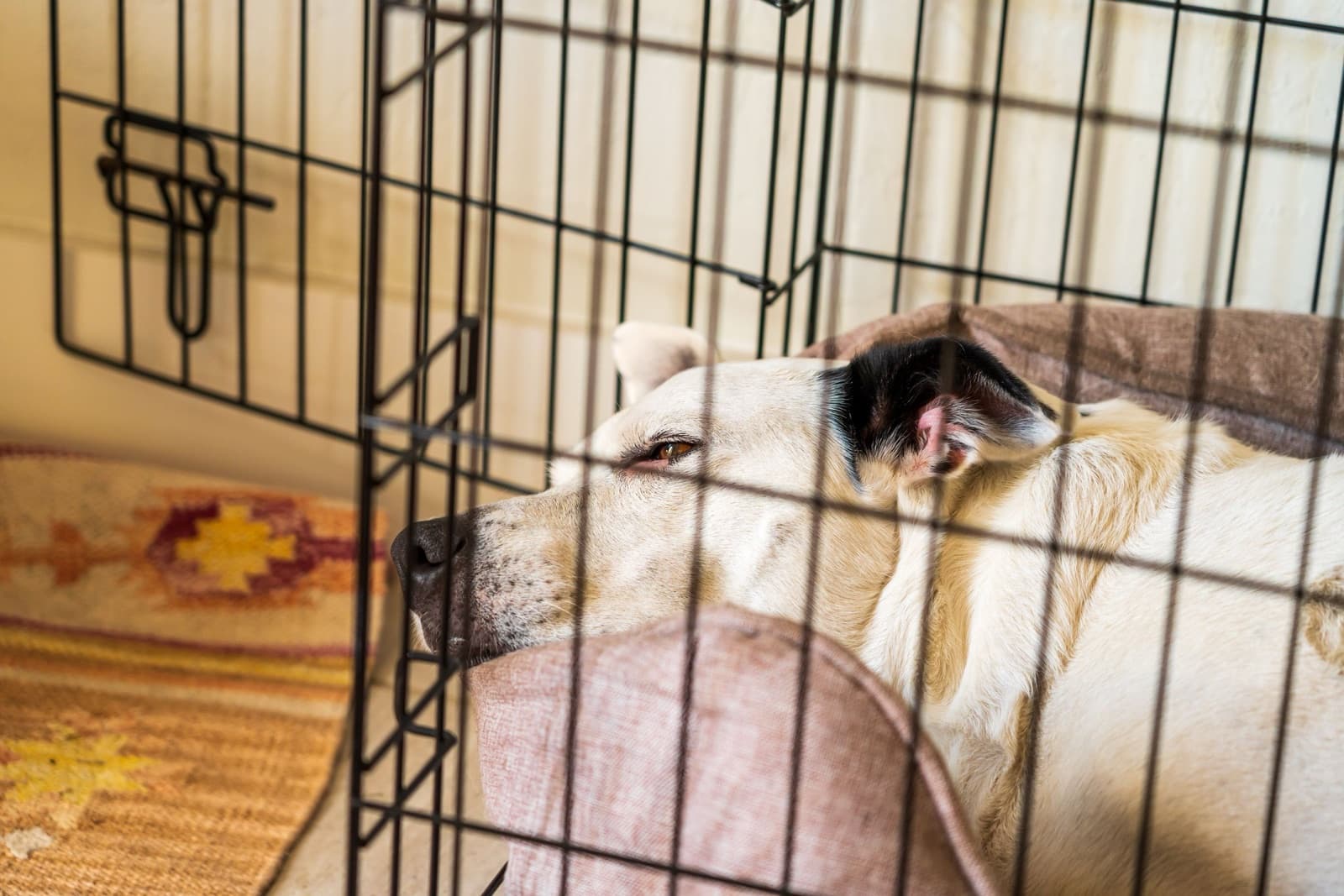
- Set up the crate or pen before the puppy sees it, so arriving involves nothing being built around it. Where and how are covered in the crate training guide.
You do not need most of what is marketed to new owners. A crate sized for the adult dog with a divider, a bed, two bowls, a flat collar with an ID tag, a lead, a harness, a long line for later, poo bags, a couple of chew items and whatever food the puppy is already eating will cover the first month.
Day one: the journey and the first evening
Bring a towel, water, and a second person if you can — somebody in the back with the puppy, in a crate or carrier, is safer and calmer than a puppy loose on a lap.
When you get home, go straight to the toilet spot before going inside. Then let the puppy explore one room, on its own terms. Resist the visitors. Resist the photographs, mostly. A puppy that has just left its mother, its litter and the only place it has known does not need a party.
That first night will probably be bad. Plan for it rather than being surprised by it: crate beside your bed, an alarm set for the middle of the night, and a plan for who is getting up.
Days one to three: decompression, not training
The first seventy-two hours are for settling. Keep the world small — one or two rooms, a consistent routine, the same food. You are not behind. Nothing you skip in these three days is lost.
Two things do start immediately, because they are habits rather than lessons:
- Toilet trips, at the frequency below.
- Name and hand-feeding. Say the name, puppy looks, food appears. That is the whole exercise, a few times a day, and it becomes the recall you will rely on for a decade.
The first week: sleep and toilet training, and not much else
Toilet trips go out on a schedule, not on a hunch: after waking, after eating, after playing, and roughly every hour or two in between while awake. Go outside with the puppy every single time — you cannot reward what you did not see, and a puppy sent out alone often comes back in and then goes. Reward outdoors, immediately, while still outside. Accidents get cleaned with an enzymatic cleaner and no comment.
Nights are the hard part. The crate goes in the bedroom for the first few weeks; a puppy that can hear you settles far faster than one shut in a kitchen, and you can hear the difference between “I am bored” and “I need to go out.” Expect one or two night trips, kept boring and wordless, and expect them to drop away within a few weeks.
The January puppy: toilet training in a Canadian winter
A puppy that arrives in February is a different project from one that arrives in June, and almost nothing written about house-training accounts for it.
- Shovel and maintain a small toilet patch close to the door, before the puppy needs it. A puppy in deep snow will not toilet; it will stand there.
- Go out with them, dressed for it. Standing at the door in socks means you will cut the trip short, and cut it short at exactly the wrong moment.
- Keep trips short and purposeful in extreme cold. A young puppy has very little tolerance for it. Out, toilet, praise, in.
- Rinse the paws after walks on treated sidewalks. Road salt and de-icers are the most common winter problem for dogs in Canadian cities, and the winter care guide covers what actually works.
- Watch for a puppy that starts refusing to go out. Usually it means the surface hurts — ice, salt, or ice balling up between the toes.
Week two: handling, the first vet visit, and the world
Handling starts now and takes two minutes a day. Touch the paws, look in the ears, lift a lip, run a hand down the tail, hold a paw as though clipping a nail — each briefly, each followed by something good. Every vet visit and every grooming appointment for the next decade is easier because of this fortnight.
The first veterinary appointment is a health check as much as anything else. Bring the records. Ask what the vaccination plan is and when the series will actually finish, what parasite prevention this dog needs where you live, when to think about spaying or neutering — a question whose answer has changed for large breeds — and what the after-hours arrangement is. The vaccination guide explains the shape of the schedule so the conversation is easier to follow.
Weeks two to three: socialisation, on a deadline
The window in which new things are absorbed as ordinary is the first three months of life — it closes before the vaccination series finishes. That timing is inconvenient and it is not negotiable, so socialisation has to happen in ways that carry low infection risk: carrying the puppy in busy places, car rides, your own yard, homes of people with healthy vaccinated dogs, and a puppy class that checks vaccination records. The veterinary behaviour position is that socialising before a puppy is fully vaccinated should be the standard of care, and the vaccination guide sets out the reasoning and what a well-run class asks for.
The aim is not to meet as many dogs as possible. It is calm exposure to variety — surfaces, sounds, weather, vehicles, umbrellas, hats, hoods, mobility aids, children, and men in high-visibility jackets. What to cover, and how to tell it is working, is a project of its own. A puppy that watches a leaf blower from thirty feet away and then eats a piece of cheese has learned more than one dragged over to sniff it.
Alone time is a skill, and you teach it in week one
This is the thing most often skipped, and the one that causes the most trouble later.
Start on the first full day, in seconds rather than minutes. Puppy settled with something to chew, you walk out of the room, you come back before there is any protest. Build from there. Leave the house for two minutes, then ten, then thirty, well before you need to leave for real.
A puppy that has never been alone until the day everyone goes back to work learns that being alone is an emergency. Undoing that takes months.
Biting is normal and it is manageable
Puppies bite. It is how they investigate, and it is not aggression. What works is boring and consistent: when teeth land on skin, the fun stops for a moment — hands still, attention off, no drama. Redirect onto something legal. Make sure the puppy is actually getting enough sleep, because most spectacular biting is an overtired puppy rather than a badly behaved one.
Puppies sleep a great deal, in many short bouts rather than one long stretch. The figures repeated online — eighteen or twenty hours a day — run ahead of what has actually been measured: the Generation Pup cohort study put owner-reported sleep at a mean of about 11 hours over 24 hours at sixteen weeks, with the caveat that owners were not observing directly. Enforce naps in the crate or pen anyway. A great many “behaviour problems” in week three are sleep deprivation.
Week four: what settled actually looks like
By the end of the first month you are usually looking at a puppy that sleeps through most of the night, has an established toilet routine with occasional accidents, will settle alone for short periods, has a name it responds to, and has been handled enough that the vet visit is uneventful.
You are probably not looking at a dog with reliable recall, a dog that walks nicely on a lead, or a dog that is house-trained without supervision. Those come later — lead walking and recall are their own project — and expecting them now is the fastest route to feeling like a failure.
The puppy blues are real
A lot of people feel flat, trapped or openly regretful in the first few weeks, and almost nobody says so out loud. It is common, it is not a verdict on you or the dog, and it lifts for most people as sleep returns. Talking to other owners helps more than most things — the community is full of people two months further along than you.
The paperwork Canadians forget
- Municipal licence. Canadian municipalities commonly require dogs to be licensed — Toronto and Calgary both do, annually — often with a deadline and a fee that differs by whether the dog is spayed or neutered. What varies between cities is more than most owners expect, and your own city’s page is the only authority on yours.
- Microchip registration. The chip is useless if the registration is not in your name with a current address and phone number. Implanting and registering are two separate steps, and the second one is the one that gets missed.
- ID tag, with a phone number, on a collar the puppy wears.
- Insurance, if you are considering it, reviewed early enough to understand waiting periods, exclusions and what the policy treats as pre-existing.
- Vaccination records, photographed and stored somewhere you can find them.
The first thirty days, in order
- Week before: vet appointment booked, insurance decided, house rules agreed, floor-level puppy-proofing, crate set up
- Day one: toilet spot before the front door, one room, quiet evening, crate beside your bed
- Days 1–3: settle only — routine, same food, name game, toilet schedule
- Week one: toilet trips on a clock, night trips kept boring, first seconds of alone-time training
- Week two: daily handling practice, first veterinary appointment, records photographed
- Weeks 2–3: low-risk socialisation while the window is open, enforced naps
- Week four: extend alone time, start lead work at home, licence and microchip registration confirmed
The short version
Sleep, toilet trips, socialisation and alone-time training are the four things that matter in the first month. Everything else — recall, loose-lead walking, tricks, the perfect harness — can wait, and will go better later on a dog that is rested, house-trained, unafraid of the world and able to be by itself.
Take the photographs anyway. It is a very short month in retrospect.
Correction — September 27, 2026
We removed wording that implied buying insurance before a veterinary appointment could make an existing condition non-pre-existing. Coverage depends on the policy, including its waiting periods and definition of pre-existing conditions, and veterinary care should never be delayed for insurance timing.
For walking equipment, use our Canadian harness buying checklist to compare sizing instructions, fastening and return conditions before purchasing.