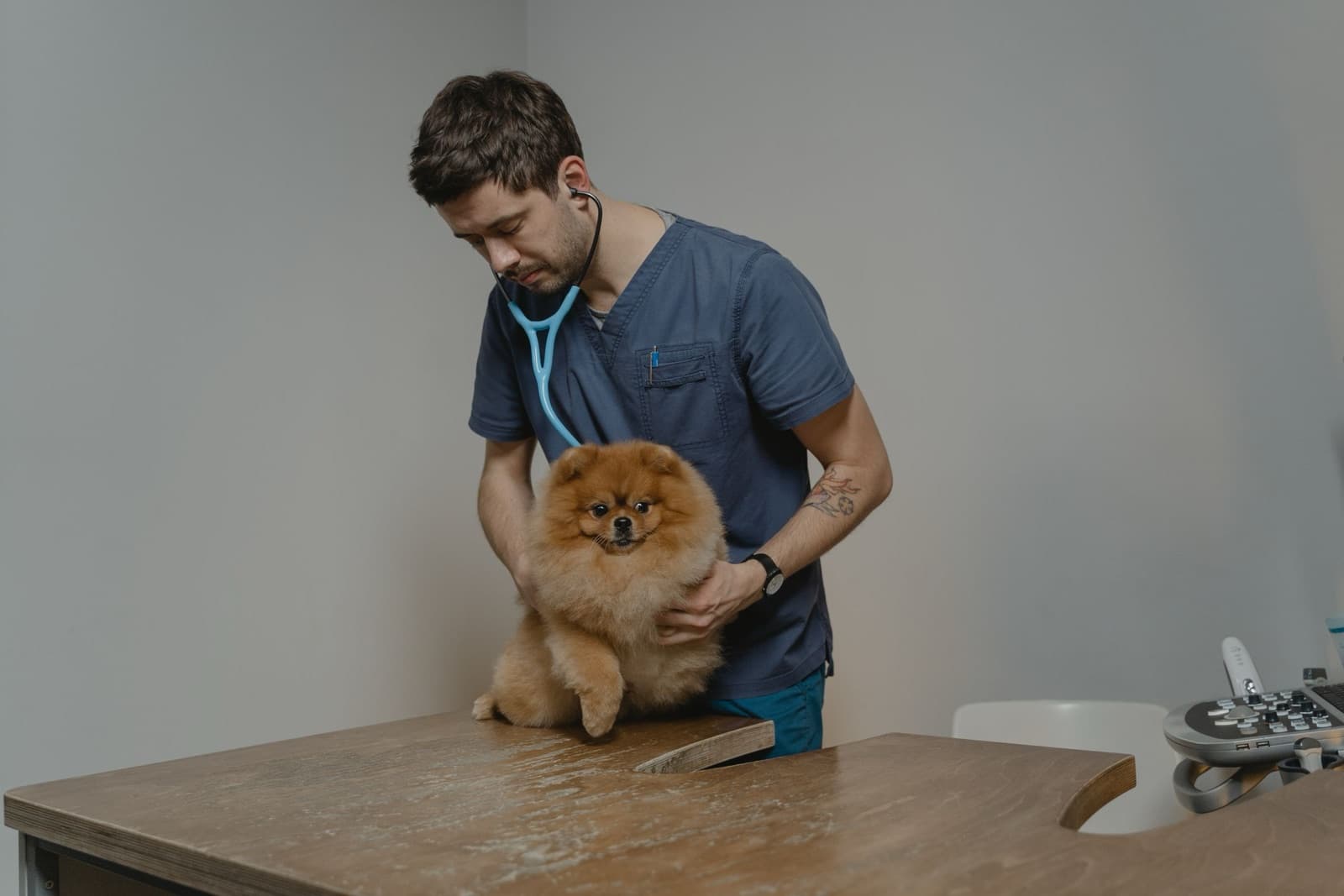
The vaccination schedule is one of the first things a new owner is handed on paper and told to follow exactly. It is also one of the few things that genuinely differs from one puppy to the next on the same street. This explains the shape a Canadian puppy schedule usually takes, why it looks like that, and which parts are decided by a veterinarian who has examined your particular dog rather than by anything you read online.
Why it is a series, and not one shot
A newborn puppy gets a temporary set of antibodies from its mother’s first milk. Those antibodies protect it through the first weeks of life — and, at the same time, they block a vaccine from taking effect.
They fade. But they fade on a schedule nobody can see from the outside: it varies between litters, and between puppies within one litter. There is no way to know which week a given puppy becomes able to respond to a vaccine.
That is the whole logic of the puppy series. It is not one dose repeated for emphasis; it is a set of attempts, spaced a few weeks apart, so that whenever the window opens for that individual puppy, a dose lands in it. The final dose — given at an age by which maternal antibodies have almost always gone — is the one carrying most of the weight.
The practical consequence: “she has had her first shot” does not mean protected. A puppy part-way through the series is part-way through the process, and the risk calculation for where you take it has not changed yet.
Core and non-core
Veterinary vaccination guidance everywhere splits vaccines into two groups.
Core vaccines are recommended for essentially every dog, because the diseases are severe, widespread, or transmissible to people. The current American Animal Hospital Association guidelines list five:
- Canine distemper virus
- Canine adenovirus, which causes infectious canine hepatitis
- Canine parvovirus
- Leptospirosis
- Rabies
The first three are usually given together in a single injection. On the paperwork it will appear as some combination of letters — DAPP, DHPP, DA2PP — which varies by manufacturer and sometimes includes parainfluenza. It is worth asking which product your clinic uses and writing it down.
Leptospirosis has moved. It was treated as a lifestyle vaccine for years, and a good deal of the advice still online reflects that. AAHA reclassified it as core for all dogs in a 2024 update to its guidelines, on the reasoning that any dog going outdoors — urban or rural — can be exposed. The WSAVA position is similar: core wherever the disease is endemic. It is a bacterial infection spread in the urine of wildlife and rodents, it can infect people, and in southern Ontario and Québec the reservoir species are raccoons and rats rather than livestock, which is what turned it from a rural problem into an urban one. If your dog's records show no leptospirosis vaccine, that is worth asking about rather than assuming it was considered.
Rabies is core everywhere the disease is present, and in some provinces it is additionally a legal requirement rather than a recommendation — see below.
Non-core vaccines are decided by where a dog lives and what it does:
- Bordetella and parainfluenza, the “kennel cough” group — usually required by boarding kennels, daycares and puppy classes, so this one is often decided by your calendar rather than your risk profile.
- Lyme disease — relevant where blacklegged ticks are established, which is a shorter list of places than people assume and a longer one than it used to be. Where they actually are, and when they are active, is worth knowing before this conversation.
- Canine influenza — situational, and worth asking about if your dog will be in group settings.
Which of these your dog needs is exactly the sort of question a veterinarian answers well and an article answers badly. Come with the details: where you live, whether you have a cottage or a farm, whether the dog will board, hike, swim, or spend time in the woods. If you have not settled on a practice yet, choosing one is the step before this one.
The shape of a typical schedule
What follows is a description, not a plan. It is what the AAHA and WSAVA guidelines say a puppy course usually looks like, so that you can recognise the shape of the one your clinic proposes and ask about the parts that differ. Nothing in it becomes due because your puppy has reached an age: what your puppy needs depends on the records it came with, its individual risk, where you live and what your veterinarian finds. That is why our Puppy Journey gives you questions at each age rather than a timetable — this table is the background those questions sit against.
| Age or stage | What usually happens |
|---|---|
| Around 6–8 weeks | First combination vaccine. Often given by the breeder or rescue before the puppy comes home, which is why the records they hand over matter. |
| Every 2–4 weeks after | The series continues, usually for two or three more doses. Two weeks is the minimum useful gap and four the maximum. |
| Past 16 weeks | The final dose of the puppy series. AAHA recommends continuing until the puppy is older than sixteen weeks, and prefers 18–20 weeks where distemper or parvovirus risk is high. WSAVA puts it at sixteen weeks or older. |
| Rabies | Timing set by provincial or municipal rules rather than by preference. Ontario requires immunization from “three months of age or over”. BCCDC recommends keeping rabies vaccination up to date; we are not presenting a province-wide legal requirement for British Columbia here, which is a different thing from saying none of the municipal, travel or bite-investigation rules apply. |
| At or after 26 weeks | The part that has changed. WSAVA's 2024 guidelines advise a dose at around six months rather than waiting for the twelve-month appointment, to catch puppies still carrying interfering maternal antibody at sixteen weeks. AAHA still frames it as a booster within one year — ask which your clinic follows. |
| After that | Intervals depend on the vaccine, the product and local law. Modern core vaccines protect for years and should not be given more often than necessary; most non-core vaccines last about a year. So not annual for everything, and not three-yearly for everything either. |
Three things are worth taking from that table. The series ends later than most people expect — the sixteen-week dose is not a formality, and for some puppies it is not the last one. The six-month dose is a recent change and your clinic may or may not have adopted it. And the intervals afterwards are set by the product and the animal, so a schedule copied from a friend in another province may not fit.
Rabies is a legal question as well as a medical one
There is no national rule, and the difference between provinces is not a technicality.
Ontario requires it. Under the province's rabies immunization regulation (R.R.O. 1990, Reg. 567, s. 1), cats, dogs and ferrets "three months of age or over" must be immunized against rabies — indoor animals included. The regulation then requires reimmunisation by the date written on the certificate of immunization, which carries the interval from the vaccine's own product monograph; Ontario's guidance summarises that as a booster within a year and then every one to three years, and warns that you can be fined if a pet is not vaccinated.
British Columbia is different. The BC Centre for Disease Control's guidance is that “your pets should be vaccinated, and their immunizations should be kept up to date” — a public health recommendation. We have not found a province-wide legal vaccination requirement for British Columbia equivalent to Ontario's, and we are not asserting one here; that is not the same as saying nothing can apply to you, because municipal licensing and animal-control bylaws, and travel and import rules, are separate questions. It is the reason advice written for one province is not portable to another.
Elsewhere, requirements can attach to the age of the animal, to its licensing, or to both, and some municipalities add their own on top. Your veterinarian is required to know what applies where they practise, so ask them directly rather than working it out from a website.
It also comes up in places people do not anticipate: licensing a dog, boarding it, enrolling it in daycare or classes, crossing the border, and — most importantly — what happens if your dog ever bites someone or is itself exposed. A dog with current, documented rabies vaccination and a dog without one are in materially different positions afterwards. Alberta publishes the clearest version of what that difference looks like. Its guidance for veterinary clinics is that cats, dogs and ferrets which are unvaccinated or which do not receive a booster promptly after exposure may require a three- to six-month quarantine, while fully vaccinated animals given a booster within 96 hours of exposure will not require quarantine at all. The decision sits with the province's public health veterinarian, not with you or your clinic, and where the biting animal cannot be found or tested the need for and length of any quarantine come from that veterinarian's risk assessment.
Read that as the shape of the thing rather than as a number to plan around. It is Alberta's framework, not the country's; other provinces run their own. What travels is the principle: after an exposure, what happens next turns on vaccination status, on how quickly a booster is given, on what the exposure actually was, and on a public-health direction that nobody can predict in advance. The one part you control is the first of those, and you control it long before anything happens.
Check the rules for your own province and municipality, and keep the certificate.
The socialisation problem
Here is the genuine tension in raising a puppy in Canada, and nobody enjoys it.
A puppy’s primary socialisation window — the period in which new things are absorbed as normal rather than assessed as threats — is, in the American Veterinary Society of Animal Behavior’s wording, the first three months of life. It closes before the vaccination series does.
Both risks on either side of that are real. Parvovirus in an unprotected puppy is a serious illness. But AVSAB's position is unusually direct about how the two compare: behavioural problems, not infectious disease, are the leading cause of death in dogs under three years old, and they are the most common reason dogs are given up to shelters. On that basis AVSAB holds that socialising a puppy before it is fully vaccinated should be the standard of care.
The answer is not to pick a side. It is to socialise in ways that carry low infection risk — and what to actually expose a puppy to matters as much as where:
- Carry the puppy. A bench outside a grocery store on a Saturday morning is an enormous amount of socialisation and involves no ground contact at all.
- Car rides that end somewhere pleasant, not only at the clinic.
- Your own back yard, and the homes and yards of people whose dogs you know are healthy and vaccinated.
- A well-run puppy class — one that requires proof of vaccination, keeps groups small and disinfects the floor between sessions. AVSAB puts classes as early as 7–8 weeks, with a puppy having had at least one set of vaccines a minimum of seven days before the first class, plus a first deworming. A class that asks you for none of that is telling you something.
- Novelty at home: umbrellas, hats, hoods, sunglasses, bicycles, vacuum cleaners, mobility aids, the recycling truck, people of different ages and appearances, floor surfaces, stairs.
And places to wait on: dog parks, pet store floors, highway rest stops, and any communal grass where a large number of unknown dogs pass through.
Titres, spacing and exemptions
Antibody titre testing measures whether a dog carries antibodies to particular diseases, and it is a real option that some owners discuss with their veterinarian, particularly for adult boosters. Two honest caveats: it does not measure everything a vaccine does, and where rabies vaccination is a legal requirement, a titre generally does not substitute for it.
Some owners ask about spreading vaccines across more appointments. That is a conversation to have with your clinic, not a plan to build on your own — spacing changes the timing of protection, and the timing is the entire point of the puppy series.
The record is a document you will actually use
Whatever paperwork the breeder, rescue or clinic gives you, keep it, and photograph it so it is on your phone.
You will be asked for it when you license the dog with your municipality, board it, enrol it in daycare or a class, buy insurance, travel, or move to another province. Reconstructing a lost vaccination history means starting parts of it again.
Worth asking at the first appointment
- Which vaccines is my puppy getting today, and which are core versus lifestyle for where we live?
- When is the next one due, and when does the series actually finish?
- What are the rabies requirements in this province and municipality, and when will you give it?
- Given where we live and what this dog will do, do you recommend leptospirosis, Lyme or Bordetella?
- Where can I safely socialise before the series is complete?
- What should I watch for this afternoon, and what number do I call after hours?
The short version
The series exists because nobody can see when a puppy becomes able to respond, so it takes several attempts and the last one — past sixteen weeks — is the one that counts. Core now includes leptospirosis; if your records do not show it, ask. Rabies is a legal matter in some provinces and a strong recommendation in others, so find out which you are in. And socialise deliberately in low-risk ways while the window is open, because it closes before the needles do.
Then keep the card. You will need it more often than you expect — including at the first appointments of the first month, which is where most of these questions first come up.